

In part 1 we look at the pioneers of textile art. Artists of different nationalities who together began to claim fabric as a form of cultural expression, placing it in the history of art, through abstract concepts and themes linked to war, feminism, issues related to contemporary socio-politics and its origins.
Textile Art is an artistic discipline in which natural or synthetic fibers are used to construct contemporary artworks, encompassing sculptures, installations, and wall objects reminiscent to painting, in the form of tapestries, weaving, embroidery, knitting and crocheting.
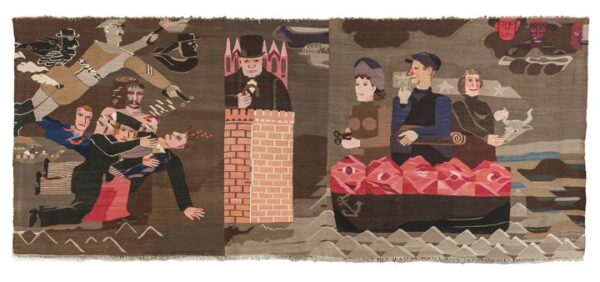 Hannah Ryggen, “6 October” (1942/ 6 Oktober 1942, 1943)
Hannah Ryggen
Hannah Ryggen, born in 1894, was a Swedish- Norwegian textile artist. Self-taught artist who developed a committed and political work producing narrative tapestries criticizing war, power and authoritarianism, using materials found in her surroundings and dyes made from natural materials. She used vertical loom built by her husband, the painter Hans Ryggen. From that small rural farm, where the couple used to live, in a Norwegian fjord some of the most surprisingly fierce and critical accounts of 20th century history was woven. Her carpets produced during the Second World War express her deeply rooted pacifist and socialist principles and even after the war her commitment to peace and ethics remained firm in the artist’s work. A satirical Hitler, criticisms made of the Vietnam War, authoritarianism and fascism are some of the approaches made in the artist’s interesting work.
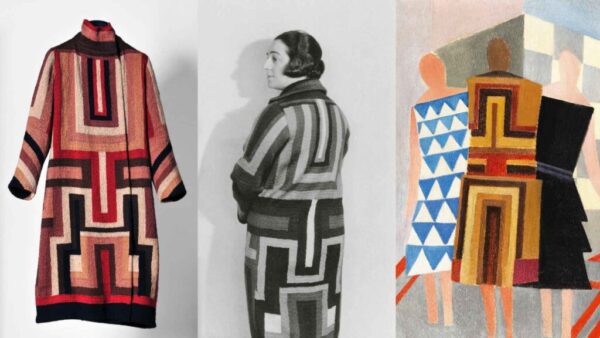
Sonia Delaunay wearable art
Sonia Delaunay
Sonia’s innovative work in textile design came shortly, in 1911, through a patchwork blanket that the artist sewed for her newborn son. During the First World War Sonia began working as a costume designer for the avant-garde Russian Ballet. At that time, he embarked on a trip to Portugal and Spain, opening his clothing and home products atelier in the Spanish capital. When he returned to Paris, the eye-catching patterns of his “wearable art” clothes began to attract wealthy, high-profile clients, including American film star Gloria Swanson and English model Nancy Cunard, epitomizing the liberation and freedom of the time. The clothes were deliberately cut to fit the women’s real lives, allowing them to work, play sport, dance, making her a pioneer of feminism. In a career spanning 60 years, her work is synonymous with kaleidoscopic colors and prismatic designs that seem fragment, shift and dance before our eyes. The multidisciplinary artist’s diverse works span painting, textiles, fashion design, costumes and interiors, making her one of the greatest pioneers of the modernist era.
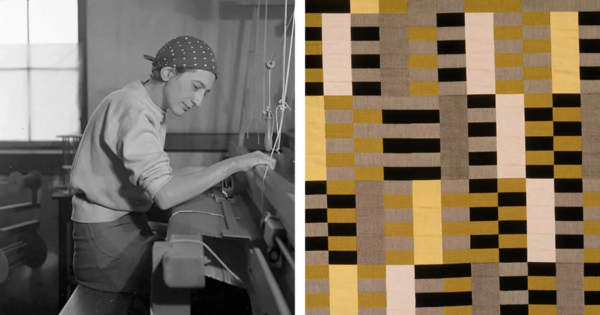
Anni Albers in her studio and the piece “Hanging” (1967)
Anni Albers
German artist and textile designer Anni Albers began her career at the prestigious Bauhaus in 1922. Albers did much of her weaving in the 1950s in her home in New Haven, Connecticut. She used a small hand loom to create these pieces, several of which incorporate a technique known as leno or gauze weaving, where vertical warp threads twist around each other and around horizontal weft threads. During her career she experimented with lithography, painting, printmaking, jewelry design and weaving. Albers, through her work, wanted to recover the sense of touch that she felt had been lost due to the number of handmade objects in the contemporary world. She liked to make works of art that awaken our touch and make us want to feel them.
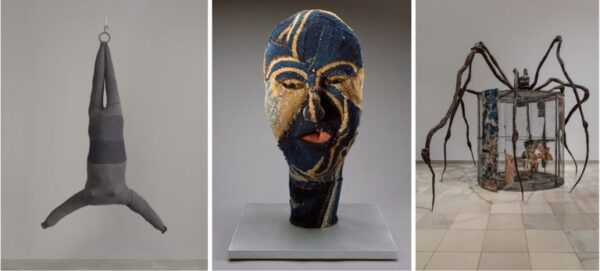
Louise Bourgeois work´s in The Hayward Gallery
Louise Bourgeois
Louise Bourgeois was one of the most renowned sculptors in the world, being well known for her large pieces for public spaces, sculptures of spiders that should remain outdoors given their scale and size. Throughout her vast career, she has worked in most of the avant-garde artistic movements of the 20th century, but has always remained uniquely individual, powerfully inventive and often at the forefront of contemporary art. Starting in the 1960s, she began using her own clothes and those of her loved ones as components of her sculptures and designs: a reincarnation of her childhood and past. Her art expanded into new areas when she began weaving patches of iridescent colored fabrics, creating works that ranged from flower figures to chromatic abstractions, constituting a repertoire of truly surprising interweaving. Throughout her career, Bourgeois has embraced feminist themes that challenge traditional gender roles and societal expectations. Her works, whether sculptures, paintings or installations, often explore the female experience with raw, unflinching honesty.
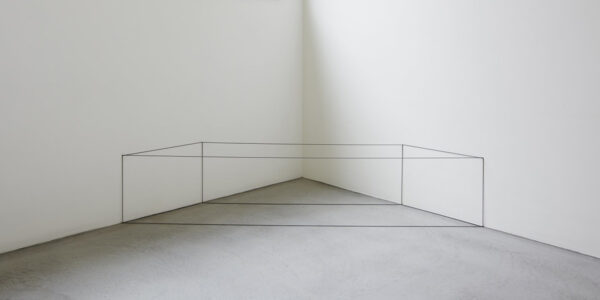
Sandback-Le Fil d’Occam, Galerie Marian Goodman-Paris, 2018
Fred Sandback
Born in Bronxville, New York, in 1943, Fred Sandback studied philosophy and sculpture at Yale, where he met minimalist artists Donald Judd and Robert Morris. Sandback worked with elastic cord and acrylic thread to delineate or bifurcate the three-dimensional space, creating volumetric shapes that fill the space. Through his immersive pieces, the artist sought to challenge the viewer’s perception of space and change the way they interact with their surroundings. Despite this relationship with the built environment and the practice of drawing, he became known mainly as a minimalist sculptor, being part of the movement of the time. His work evokes references to architecture, painting, sculpture and even music, given his early fascination with stringed musical instruments.
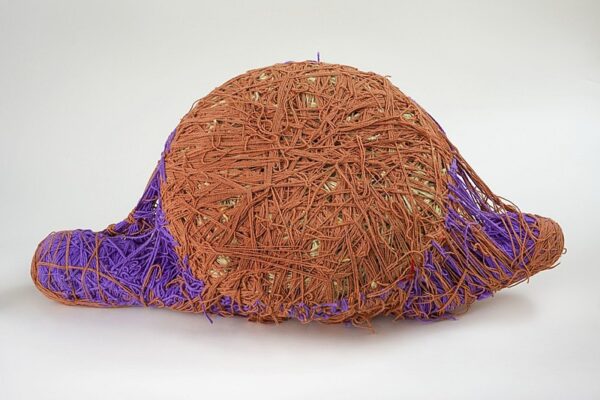
Untitled. Judith Scott
Judith Scott
Judith Scott was born in Columbus, Ohio, in 1943, with Down syndrome and deafness, being isolated from social life from a young age. She remained speechless her entire life. Scott began creating art at age 43 and textiles quickly became her passion. Over the next eighteen years she created sculptures using threads, ropes and straps for wrapping and knotting, creating a series of mundane objects she discovered around her, such as keys, plastic tubes, bicycle wheels and a shopping cart. Scott’s vivid and enigmatic sculptures, which evolved in form and material throughout her career, expressed her imagination in ways she could not through speech. She continued her work until her unexpected death from natural causes in 2005, at nearly 62 years old. She lived almost 50 years longer than expected when she was born.
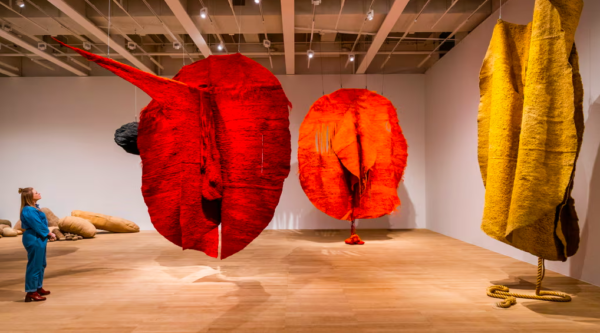
Magdalena Abakanowicz in the Tate Modern. 2022
Magdalena Abakanowicz
Polish artist Magdalena Abakanowicz pioneered fiber-based sculpture and installation in the 1960s. She used easily accessible fabrics and soft materials, creating large constructions that could be shields or shelters. Abakanowicz began making figurative works with fiber and burlap, the rough, tactile surfaces suggesting physical or psychological scars earned over a lifetime. What she did was so radical that it still surprises us today. She took the conventional flat tapestry woven for thousands of years and remade it in three dimensions. Her weavings are vast objects suspended in space that can appear human – large heads, enormous anatomies – or can be organic, from hills to branches to serpentine spirals and vines. She was capable of weaving in different materials, tensions and densities all at once, of piecing fragments seamlessly together.
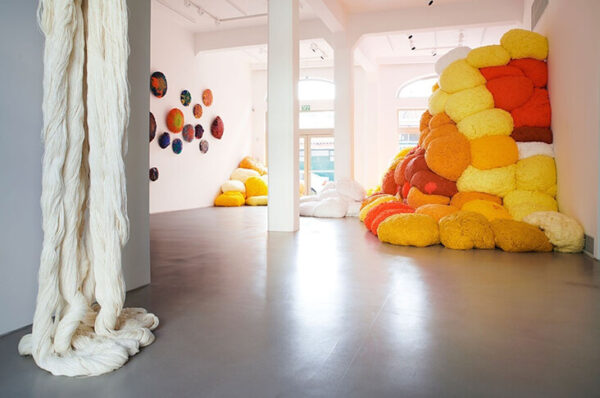
Migdalor at Magasin III Jaffa, 2018.
Sheila Hicks
Sheila Hicks is an American artist who lived and worked in Mexico and later settled in Paris. Captivated by structure, shape and color, through weaving she created her works on varying scales, from small handmade fabrics to sculptural fiber pieces on monumental scales. Her work is known for experimental, innovative weaving and sculptural textile art that incorporates natural materials, personal narratives and distinctive colors. Her diverse approach to textiles placed her at the center of the growing Fiber Art movement of the 1960s and 1970s. “Textile is a universal language. In every culture around the world, textiles are a crucial and essential component,” she said.
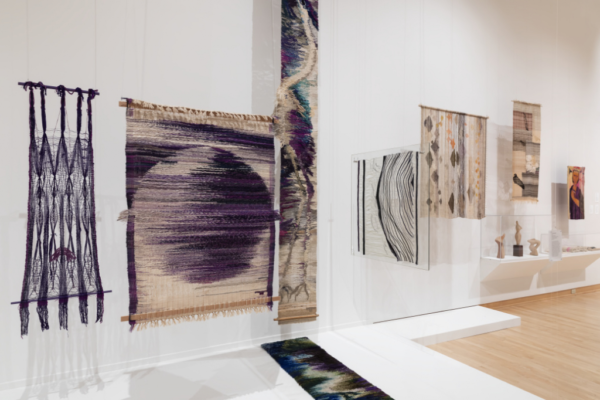
The Work and Studio installation of Lenore Tawney at the John Michael Kohler Arts Center, 2019
Leonore Tawney
American artist Lenore Tawney was undoubtedly one of the most important figures in the fiber movement of the 1950s and 1960s, redefining the possibilities of weaving and paving the way for the explosive growth of fiber art in subsequent decades. The artist developed a multifaceted practice that included monumental sculptural installations, box-shaped assemblages, intricate collages, and graphic drawings. Tawney’s main material was linen thread, a component found in almost all of her three-dimensional compositions and the basis of her creative process. A contemporary of the minimalist and feminist movements of the time, Lenore created a new vocabulary for textile work, subverting the typical woven grid and inventing new ways of weaving beyond the traditional limits of the loom. To emphasize the sculptural qualities of her works, Tawney stated that they hang in the space rather than on the wall.
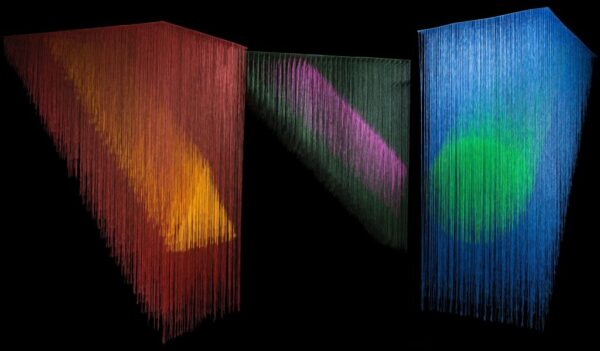
Brumas (detail), 2013. The Patinoire Royale- Galerie Valerie Bac
Olga de Amaral
The Colombian artist, born in 1932, was one of the great names in textile sculptural art alongside Magdalena Abakanowicz, Sheila Hicks and Lenore Tawney, contributing to the growing acceptance of fiber art as a legitimate and consequential category of art making, worthy of attention and criticism. Using multiple registers of spirally wound, braided and joined vertical threads, Amaral modulates surface, depth and negative space to create a pulsating structure that appears both architectural and organic. In their rhythmic arrangement, clusters of strings grouped and separated at intervals appear to be encoded with a subliminal or haptic meter, evoking the Inca practice of record keeping through knots and grouping of fibers in a quipu.
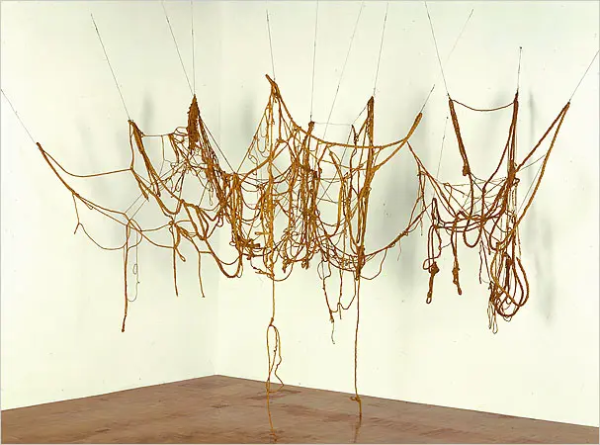
Untitled (1970)
Eva Hesse
Eva Hesse was an American sculptor born in Germany in 1936. Hesse graduated from the New York School of Industrial Art at age 16. From 1954 to 1957 she studied at Cooper Union and in 1959 received her bachelor’s degree from Yale University. In New York, in the 1960s, Hesse was part of a group of artists who dedicated themselves to flexible, viscous or soft materials: latex rubber, plastic, lead, polyethylene, copper, felt, chicken wire, dirt, sawdust, paste of paper and glue. She is associated with the post-minimal art movement and her work is often seen in the context of the many struggles of her life. These include fleeing the Nazis, her parents’ divorce, her mother’s suicide when she was 10 and her father’s death. A 2016 documentary titled Eva Hesse, premiered in New York, showed the relationship between her private life and her history in art.
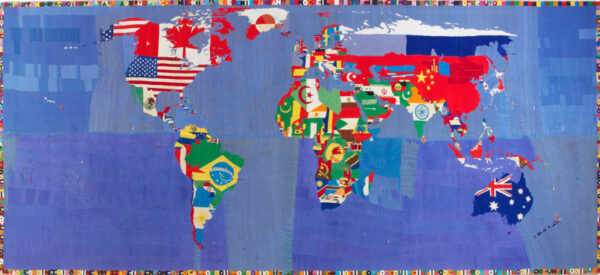
Mappa (1989)
Alighiero Boetti
Italian artist Alighiero Boetti is known for a series of embroidered world maps, Mappa, created between 1971 and 1994. Conceptual artist and member of the Arte Povera movement, Boetti in 1967, after the Six-Day War in Israel, created Twelve Shapes that portrays the various political crises of the conflict through maps. He also frequently designed fabrics to be embroidered in artisan workshops, and from 1987 until his death, Boetti was completely absorbed in the creation of his largest and most complex tapestry, Tutto, which was created to represent the world’s cultural diversity. His large Map of the World is on permanent display as an important element of the collection of the Museum of Modern Art in New York.
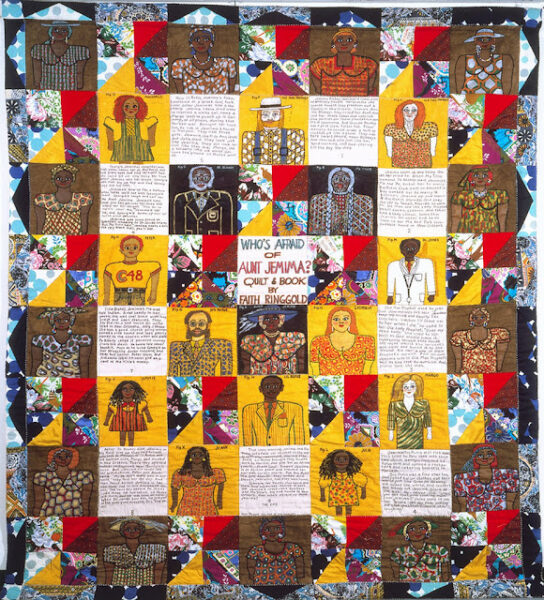
Whose Afraid of Aunt Jemima? (1983) Painted Story Quilt by Faith Ringgold
Faith Ringgold
Faith Ringgold was a multidisciplinary artist and activist best known for her work narrative quilts using weaving to portray a message or tell a story. Ringgold quilted her stories to be heard. Once she said: “In 1983, I began writing stories on my quilts as an alternative. That way, when my quilts were hung up to look at, or photographed for a book, people could still read my stories.” and her first quilt story Who’s Afraid of Aunt Jemima? (1983) depicts the story of Aunt Jemima as a matriarch restaurateur and fictionally revises “the most maligned black female stereotype.” Another piece, titled Change: Faith Ringgold’s Over 100 Pounds Weight Loss Performance Story Quilt (1986), engages the topic of “a woman who wants to feel good about herself, struggling to the cultural norms of beauty, a person whose intelligence and political sensitivity allows her to see the inherent contradictions in her position, and someone who gets inspired to take the whole dilemma into an artwork”
(© cover photo Alina Grubnyak)