

In part 2 we look at the textile and fiber artists who continued the language of their predecessors, pushing the limits of textile art in scale and format. Gender, social and political themes continue to be an issue for this generation that is also beginning to talk about the AIDS epidemic, ecology and flirting freely with fashion and design.
Textile Art is an artistic discipline in which natural or synthetic fibers are used to construct contemporary artworks, encompassing sculptures, installations, and wall objects reminiscent to painting, in the form of tapestries, weaving, embroidery, knitting and crocheting.
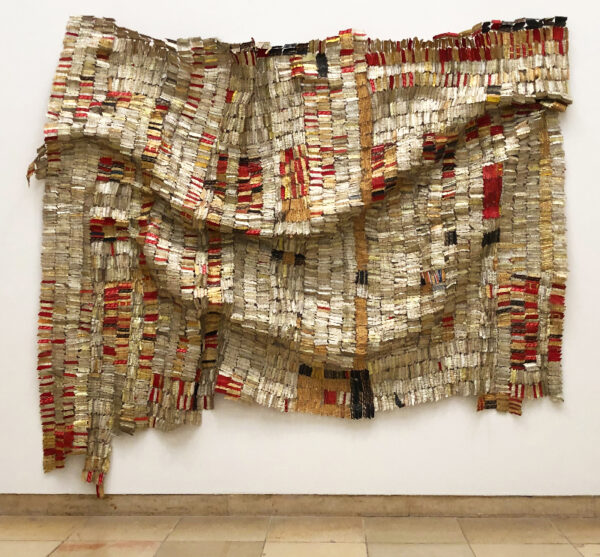
El Anatsui: “Man´s Cloth “, 2005, aluminium and copper wire
El Anatsui
El Anatsui was born in Ghana in 1944 and lives in Nigeria. His sculptural work, composed of large metallic tapestries, constructed with bottle caps and copper wire, has a striking presence due to its aesthetics physical weight and big scale. The pieces are the result of experimentation with different local materials and varied forms of crafts. The way he works is similar to that of patchworks, working with scraps of fabric or found fabrics. In many ways, Anatsui’s work resembles traditional African kente cloth, which is made by interweaving long strips into a patchwork quilt. For the artist, son and brother of professional kente weavers, this fabric ends up being a personal reference to a great symbolic power being appreciated in his work.
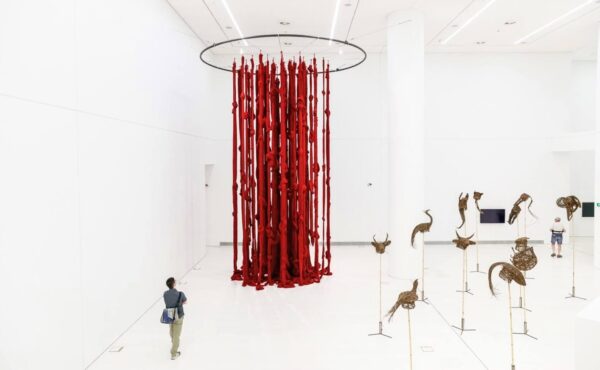
My Quipu Womb, at EMST, Museum of Contemporary Art, Athens, documenta 14
Cecilia Vicuña
Cecilia Vicuña, born in 1948, is a Chilean activist, poet and artist who lives in New York and Santiago, Chile. In the 1960s, Vicuña began working with the quipu form, which is a recording device made of knotted strings used by the Incas and other Andean cultures of South America. The word “quipu” comes from the Quechua word for “knot.”. Her modern approach to the ancient form of communication is to protest environmental or social issues, including women’s rights, with soft sculptures that have a striking and visually captivating presence. In 2017, she exhibited Quipu Womb, a colossal installation made of long knotted strands of blood-red wool, suspended from the gallery’s ceiling. Referencing the process of menstruation, her sculpture was a celebration of the vital power of women, while also connecting Andean and ancient Greek mythologies.
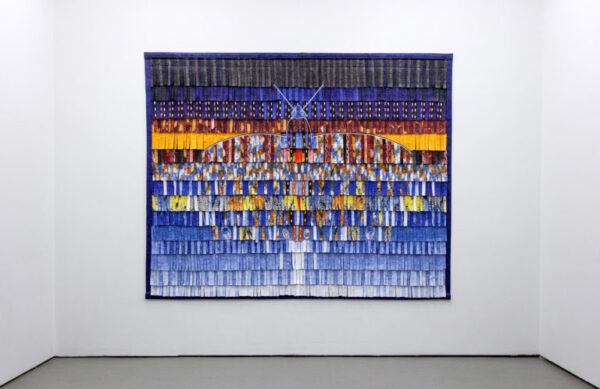
Le Papillon Bleu, 2016. 246 x 308 cm
Abdoulaye Konaté
Abdoulaye Konaté, born in Diré in 1953, is a Malian artist who lives and works in Bamako, where he studied painting at the Institut National des Arts de Bamako. In 1978, the artist moved to Havana, Cuba, continuing his artistic training in that country and in 1990 he switched from traditional painting to tapestry. Her work reflects on how fabric can celebrate and communicate motifs that range from ancestral to contemporary. His abstract compositions address ecological and social issues such as climate change, globalization and the AIDS epidemic. His tapestries are displayed in galleries around the world today.
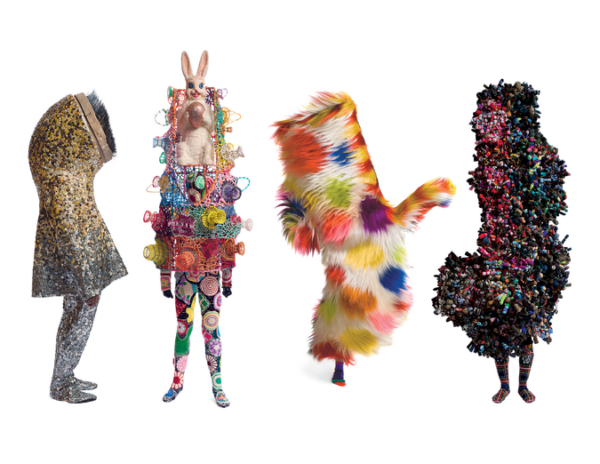
Soundsuit, 2010. Mixed Media. Nortom Museum of Art
Nick Cave
Nick Cave is a sculptor, performance artist and dancer, born in 1959. He is best known for his Soundsuit series: wearable fabric sculptures that are bright and whimsical. Cave’s first soundsuit was created in 1992 and is a sculptural suit that wraps the wearer’s body in materials including dyed human hair, sisal, beads, plastic buttons, sequins, wire, and feathers among others. Soundsuits are intended to hide the body, thus avoiding any judgment about race, gender and class, forcing the viewer to look neutral. The artist often incorporates dance and performance into his work. His later sculptures focused on color theory and included large-scale media and installations. Currently, Nick lives in Chicago and directs the fashion graduate program at the School of the Art Institute of Chicago, also continuing with Soundsuits.
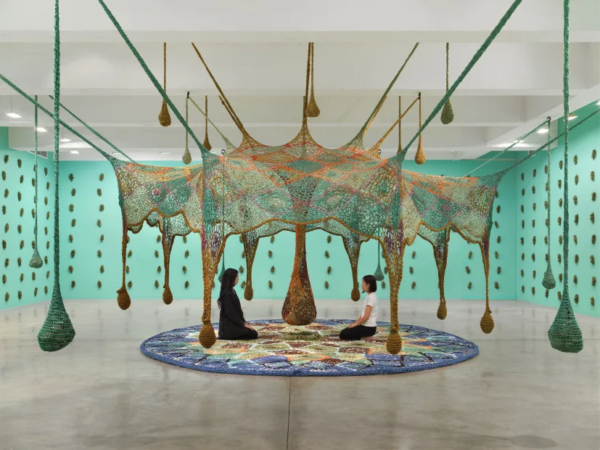
Between Earth and Sky, 2002 in the Tanya Bonakdar Gallery
Ernesto Neto
Ernesto Neto is a Brazilian artist, born in Rio de Janeiro in 1964. Neto’s work has been described as abstract minimalism and appears to have been created to be penetrated, inhabited, felt and even smelled, allowing viewers to experience their own bodies, feelings and minds through interaction with his works. His installations are large, soft, biomorphic sculptures made of elastic material – amorphous shapes filled with Styrofoam balls or, occasionally, aromatic spices. In some installations, he also used this material to create translucent screens that transform the walls and floor of the space. His sculptures can be considered an expression of traditional abstract form, but in their interaction with the viewer, they also function on another level.
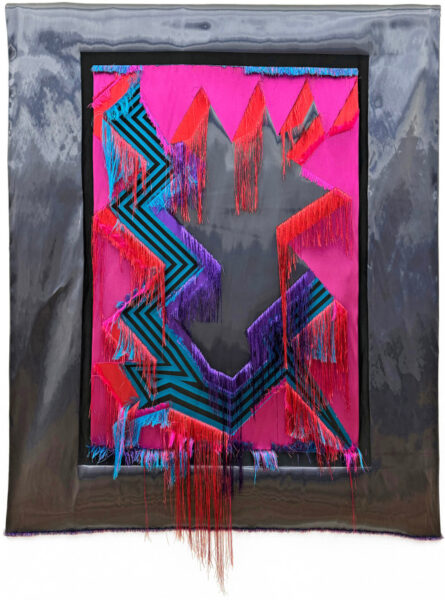
Fractured Sky (2023) Lurex, monofilament, polyester, and silk in the Luis De Jesus Los Angeles Gallery
Liz Collins
Liz Collins, born in 1968, is an American contemporary artist, teacher and designer recognized for her work involving fabrics, knits and textiles. She launched her own knitwear-focused fashion brand with a presentation in New York during fashion week. He spent the following years expanding his company, designing, producing, exhibiting and selling clothes for the international fashion market, in addition to providing consultancy for other brands. Her fashion brand has shifted to a project-based venture, with occasional forays into capsule collections. Liz has a strong background in textile media, including transitioning fabrics into multidimensional shapes as a method of varying the scale of her pieces to make them more architectural. Currently she also works with recycled fabrics.
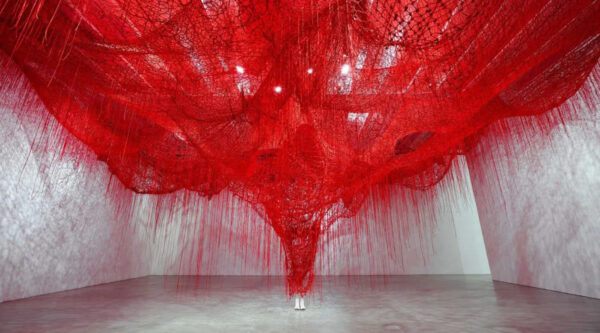
“Me, Somewhere Else” at Blain Southern Gallery, London. 2019
Chiharu Shiota
Chiharu Shiota, performance and installation artist, was born in Japan in 1972. Since 1996, she has lived and worked in Berlin. Her work intertwines materiality and the psychic perception of space to explore ideas around the body and flesh, personal narratives involving memory, territory and alienation. The artist is primarily known for her vast webs of wires or hoses connecting abstract networks with concrete everyday objects such as keys, window frames, dresses, shoes, boats and suitcases. Her installations, which consist of intricate networks of threads that stretch throughout the gallery’s rooms, made the artist famous in the 2000s. Shiota has exhibited worldwide and had famous artist Marina Abramovic as her teacher.
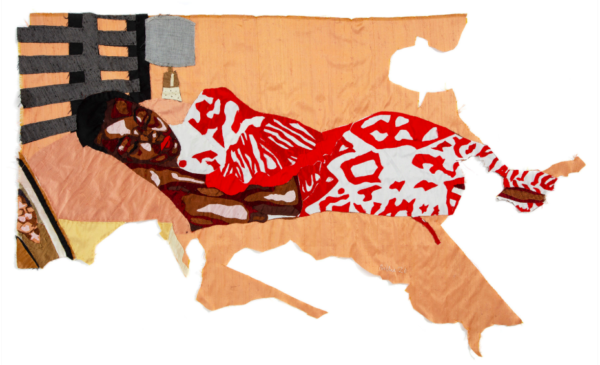
An Angel at My Bedside, 2020. Hand-stitched silk collage
Billie Zangewa
Billie Zangewa is a Malawian artist, born in 1973, who sews silk fabrics by hand to create collage tapestries. The process of refining silk especially resonates with the artist due to its associations with metamorphosis, and her finished tapestries celebrate imperfection with their rough, jagged edges and often large, seemingly cut-off pieces that seem to get in the way of the scene. Her work is characterized by scraps of raw silk in intricate colorful collages, sewn by hand, creating figurative compositions on a flat support. Almost always the protagonist of her works, Zangewa illustrates his daily life, also bringing a narrative reflection on historical stereotyping, objectification and exploitation of the black female body. The artist finds importance in the everyday practicality of the fabric, which brings something familiar to her work and follows the focus on valuing domesticity.
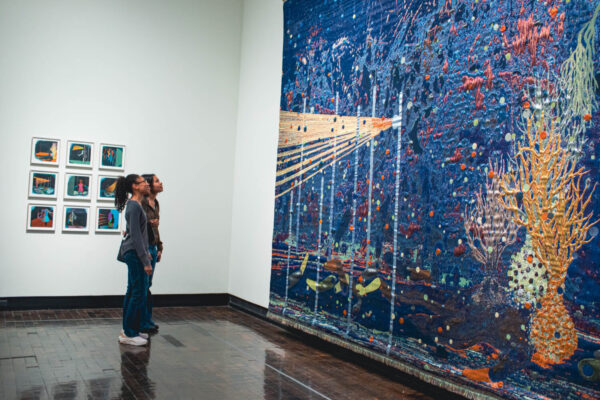
Tied to the Other Side, 2021 in the Gordon Contemporary Artists Project Gallery
Otobong Nkanga
Otobong Nkanga, born in 1974, is a visual artist, tapestry maker and performance artist born in Nigeria and based in Antwerp, Belgium. Throughout her work, Nkanga explores themes of neocolonialism, ecological violence and environmental protection by addressing the social and topographical changes of his environment, observing their inherent complexities and understanding how resources such as soil and land, and their potential values, are subject to regional and cultural analyses.
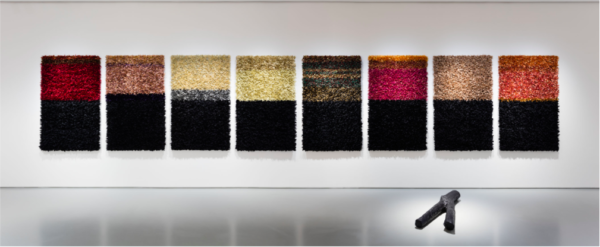
Last Year in Antananarivo. 2016 in the Tyburn Gallery
Joël Andrianomearisoa
Joël Andrianomearisoa is a Malagasy artist and architect, born in 1977 in Madagascar. He currently lives and works between Paris and his hometown. His work has a monumental and poetic technique and his favorite techniques include textiles and drawing. In 2019, he was invited by Dior to make his own version of the Lady Dior bag, which, for this occasion, was named Lady Dior Art. He worked on the entire Lady Dior Art environment, from the lining to the packaging. He says he created two versions of the object that he will call “Lady Dior’s labyrinth”.
(© cover photo Dannie Jing)